Everything digital rests on physical infrastructure: from the server to the power grid, and from the solar farm to the cloud.
We save a photo to the cloud, and it can take less than a second. It seems to cost nothing. But in that second, the photo crosses a telecommunications network, reaches a building full of servers and consumes electricity that is being generated at that very moment, in a power plant, a wind farm or a solar farm.
The foundation of it all: the power supply
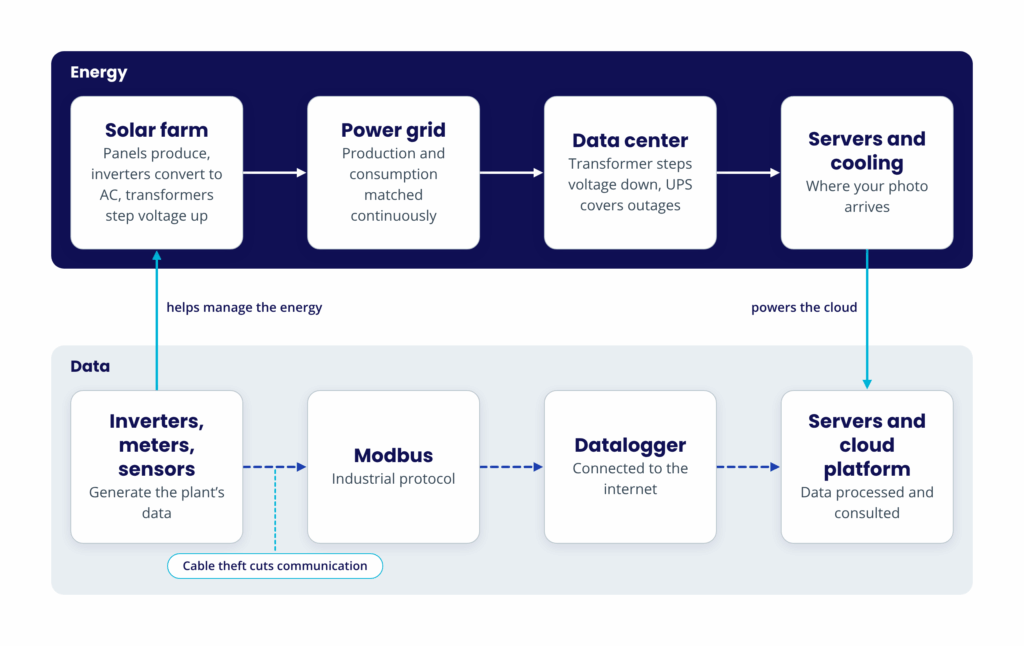
Let’s start with the data center, the physical building your photo reaches. The first thing it needs is electricity, and getting it isn’t as simple as plugging in a household appliance: in a large facility, the grid usually delivers the power it needs at medium voltage, and a transformer steps it down to a voltage that can then be distributed throughout the building. It’s similar to what any phone charger does on a small scale. From there, switchboards and a cabling network carry it to the servers and cooling systems.
But it isn’t enough for the electricity to arrive: it has to arrive with high quality and without interruptions. That’s why there’s a UPS (uninterruptible power supply) along the way: it usually delivers a clean electrical signal to the equipment, independent of the grid’s, and has batteries that bridge an outage until the backup generators start up. If the grid fails and everything responds as designed, no one notices the handover.
What lies behind the plug: the power system
And none of this works without something that sits outside the building: the interconnected power system, a vast and highly complex network that links the plants that generate electricity, the lines that transmit it over long distances and those that distribute it to every consumer.
Its basic rule is simple: the grid doesn’t store electricity on its own, so what is produced and what is consumed must be balanced continuously. That’s why, to a large extent, the electricity behind your photo is being generated right now.
And that grid is changing. In Spain, according to Red Eléctrica, more than half of the electricity generated in 2025 was renewable, and sun and wind depend heavily on the weather. Operating a system like this requires measuring how much each plant produces, forecasting how much it will produce and coordinating it all in near real time. Those measurements come largely from equipment installed at each plant.
From the field to the cloud: the journey of a data point
So far, the digital relies on the physical. But the reverse is also true: physical infrastructure is monitored and managed with digital tools. A solar farm is a good example, because energy and information coexist there. Here, energy travels in the opposite direction to the data center: the panels generate it, the inverters convert it into alternating current and the transformers step up the voltage to feed it into the grid.
Information takes a different route. Inverters, meters and solar irradiance or temperature sensors generate data that travels over Modbus, an industrial protocol, to a datalogger, a recording device connected to the internet. From there, it moves on to servers and to the cloud platform where it is processed and accessed.
Each stretch has its own physical dependency, and sometimes the root of a problem isn’t where it seems. Cable theft is fairly common at solar and wind farms and in distribution networks: data stops arriving or stops adding up, and from the monitoring platform it’s hard to understand why. On several occasions, part of a solar plant lost communication with the meter because of cable theft, which was detected by field staff. Fixing it meant checking the physical side.
That’s why, when a data point is missing, the cause may lie in the software, the communications or the power supply, and it isn’t always possible to tell at first. Behind it all, two worlds intersect: the energy that powers the cloud and the data that helps manage that energy.
When something fails: redundancy and its limits
Let’s go back to the data center. Its layers of protection do their part, but none of them alone guarantees that the service keeps running. A UPS’s batteries cover an interval, not a long outage. Add to that redundancy, that is, having extra equipment in case one unit fails. But redundancy has its limits too: redundancy within a single piece of equipment, such as a UPS’s spare modules, doesn’t protect against everything that duplicating the entire installation does. And during maintenance, a second failure can catch the system with no margin.
What’s more, protection against failures doesn’t end at the data center door. When the problem lies at the source of the data, for example internet or communication issues at a solar farm, or the cable theft mentioned above, production information arrives incomplete or doesn’t arrive at all, and no amount of redundancy in the cloud can recover data that never arrived. That’s why a service’s continuity depends on the entire chain, not just on what happens inside the building.
If you work with digital technology, perhaps the most useful question is this: what physical infrastructure does what I’m building depend on, and what happens if one link fails?
Saving a photo seems to cost nothing. But behind it lies an entire journey: energy that is generated and transmitted, a building that receives and safeguards it, and data that helps manage it. And the physical side tends to be taken for granted. That’s why, when the conversation turns to the full chain, it’s worth having someone from the electrical side at the table.