
“Did you go see The Odyssey? In the IMAX? 70 mm?”
This is how most conversations about Christopher Nolan’s latest adventure went this past July. I’m sure you’ve had the same conversation, or some close variation of it, with someone you know. Everywhere, from social media reels to newspaper articles, someone was trying to help you decide (or claiming to help you decide) between all those movie formats! If you are anything like me, you were probably as overwhelmed while buying the tickets, thanks to all those formats out there. There’s IMAX, 70 mm, Dolby cinema, standard digital and 35 mm. Oh wait, there are two IMAX options: digital and 70 mm. And what is IMAX dual laser?
Aaaarghhhh… and I have a background in optics and optics-based technologies!
Let’s take a deep breath. All is well, all is well!
Now you are probably wondering where I’m going with all this talk of The Odyssey and Nolan and IMAX cinemas — especially since you came here wanting to read an article about AI (hoping it’s not written by an AI, and it isn’t; this is all just the craziness of my very human brain, I swear!). Bear with me a little bit longer though, I promise I have a point.
Let’s go back and talk a little bit about the thing behind all these movie formats. Picture this: an actor is standing on set, ready to deliver a quiet, intense line, with a machine the size of a washing machine parked a few feet from their face, making a lawnmower level noise; and every two to three minutes, the take gets interrupted so the crew can reload the film. That machine, my dear reader, is an IMAX film camera. Traditionally weighed over 200 pounds with film magazines that could hold only about three minutes of usable footage before needing to be swapped out. That noise isn’t a flaw someone forgot to fix. It’s a direct, physical consequence of the exact same thing that makes IMAX footage so breathtaking in the first place. You cannot get one without the other.
That single fact — that a tool’s greatest strength and its most limiting weakness come from the same source — is the whole idea this article is built around, and it applies just as much to AI as it does to filmmaking.
THE LOUDEST CAMERA IN THE WORLD!
An IMAX frame of film is roughly ten times larger than a standard 35 mm movie frame. That’s the entire reason IMAX exists: more film surface means more captured detail, which means you can blow the image up onto a screen several stories tall and it still looks crisp instead of grainy. It’s not a marketing gimmick, it’s a real, physical difference in how much visual information gets recorded. But recording that much information isn’t free. To move a frame of film that large through the camera with precision, the machine needs a vacuum system that sucks the film flat against the lens dozens of times a second, plus mechanics strong enough to haul that much material through at speed. That vacuum system, doing its job of keeping every frame perfectly sharp, is LOUD! Loud enough, that for decades, IMAX simply couldn’t be used to shoot a normal conversation between two people. It was built for sweeping vistas and roaring action, not for whispering. So, for years, directors — including Nolan, across Interstellar, Dunkirk, and Oppenheimer — used IMAX the way one would use a specialist tool: bring it out for the huge, spectacular shots, and switch to a smaller, quieter camera the moment two characters needed to sit down and talk. Nobody considered this a compromise. It was just understanding that the tool built for scale wasn’t the tool built for intimacy, and vice versa.
Now hold that idea and set it down next to a completely different-looking problem: the “black box” nature of modern AI systems.
THE MODERN AI
A large deep learning model, the kind behind most of today’s AI systems, earns its power the same way an IMAX camera earns its resolution: by being enormous. It’s built from billions of internal parameters, tuned automatically against huge amounts of data until it becomes remarkably good at its job, be it writing, translating, recognizing images, and/or predicting outcomes. And just like the giant IMAX frame, that scale is precisely where the capability comes from. You cannot shrink the model down and keep the same performance any more than you can shrink the film frame and keep the same resolution.
But scale also creates the exact same kind of noise that the IMAX camera has. You cannot point to any single number inside a deep learning model to say: “there, that’s the reason it made this decision.” There’s no sentence in there, no clean explanation sitting and waiting to be read out. The very things that make the model powerful, the size and the complexity, is what makes it impossible to walk up close and get a quiet, precise answer to “why did you do that?” It’s loud in exactly the way the camera is loud. Not broken. Just built for a different kind of shot.
THE QUIETER CAMERA!
This is where Explainable AI (aka XAI) comes in, and it plays the same role the smaller, lighter camera plays on a film set.
XAI methods don’t try to be the whole system. They’re a separate, smaller toolkit that gets pointed at one specific question at a time: nudge a single word in the input and see how the answer shifts; check which internal signals actually switch on when the model makes a particular kind of decision; quietly disconnect one small piece of the model and see if a specific behavior breaks. Each of these, on its own, is a modest, quiet, close-up tool. None of them captures the sweeping scale of what the full model can do. But each one can walk right up to a single decision and get something the giant model itself never can: a clear, traceable, specific answer.
This is the same trade actors and directors have always made on a film set. You don’t get the epic, wall-sized resolution from the small camera. You get something else instead, the ability to work quietly, closely, and precisely, at the cost of scale. Neither camera is the correct one. They’re built for different shots.
BUT THE ODYSSEY?
Christopher Nolan’s latest cinematic epic, The Odyssey, is described as the first movie ever shot entirely on IMAX film cameras — no compromise, exactly as he wanted! That’s not hard to believe, he is, after all, a lifelong advocate for large-format filmmaking. To make it possible, IMAX built him an entirely new camera system — nicknamed the Keighley and engineered to be quieter and more workable than earlier versions — once again trusting Nolan to test and refine their most ambitious prototypes.
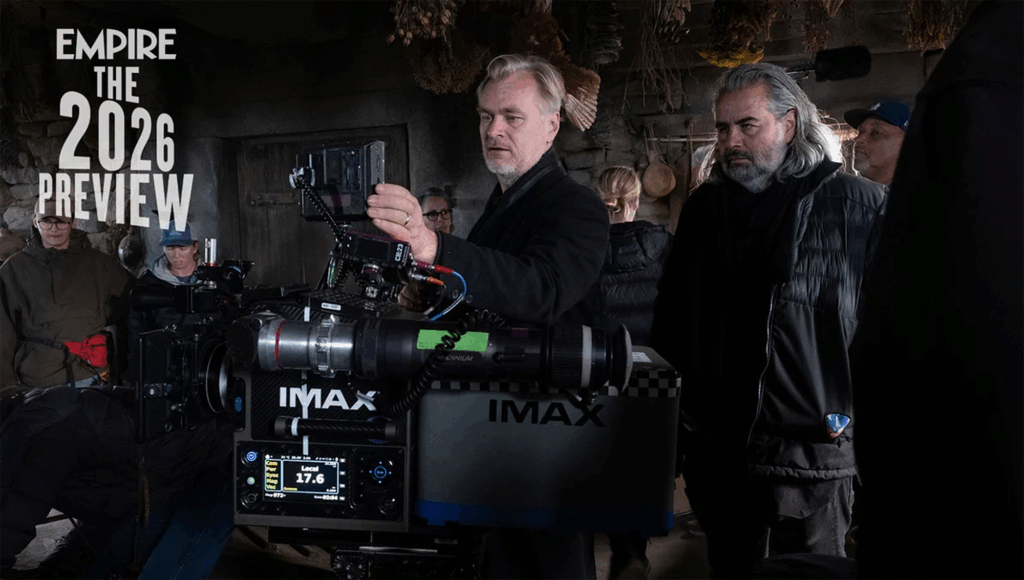
And it worked. The movie got made, entirely on IMAX film, exactly the way he wanted. But it only sort of solved the underlying problem — the trade-off didn’t completely disappear; it just got smaller. Even fully encased in its new sound-dampening housing (reportedly weighing around 300 pounds), the camera was still audible up close. Matt Damon, reflecting on shooting The Odyssey, described it as having a “blender in your face”. Better engineering did close the gap — a blender on your face is indeed better than the lawnmower we started with! And the reload time didn’t budge at all: the new camera still needed fresh film every two to three minutes, same as before, simply because that’s how much film fits in a magazine before it runs out. It’s important to remember that though the huge technological leap was made, the smaller noise is still a noise.
THE WINNER?
Ask a cinematographer whether an IMAX camera is better than a digital one. Or ask a hobby photographer if portrait mode beats landscape. Ask yourself which mode on your phone camera you always use! The answer to all of the above is: it depends! It depends on what you are trying to show. Snapping a pic of your favourite matcha and a gorgeous slice of cake for the Instagram foodies calls for a completely different shot than capturing the sweeping vista from a mountain trail for your wanderlust followers.
The same is true in AI, and it’s worth resisting the instinct to pick a side. If the problem is “recognize patterns across an enormous, messy dataset as accurately as possible,” a large deep learning model earns its size the same way IMAX earns its frame. If the problem is “tell me exactly why this specific diagnosis got flagged,” you need something closer to the quiet, close-up camera — an interpretable model or an explainability method built to answer one traceable question at a time, even if it can’t match the raw pattern-recognition power of the giant model.
And increasingly, the most serious real-world AI systems do what most films do: use both, in the same project, depending on which moment calls for which tool. The big model handles the sweeping, complex work. A smaller, quieter interpretability layer gets brought in for the moments where someone genuinely needs to understand, in plain terms, what just happened and why.
Nobody would walk onto a film set and declare one camera the winner. The scene decides. It turns out the same is true of the systems increasingly deciding things about our lives — the shot you need determines the camera you reach for, every time.