
A practical guide to understanding what they are, when to use them, and how to start building your own
Artificial intelligence has come a long way in just a few years. We’ve moved from models that simply answer questions to far more sophisticated systems: AI agents that don’t just respond, but plan, execute tasks, and call on external tools to get things done.
Setting these agents up, though, isn’t always straightforward. It’s often unclear where to start or which capabilities to «teach» them so they actually meet our needs. The problem only gets worse when every single interaction forces us to re-explain the same context, the same team rules, the same quality standards. The result: generic, inconsistent agents that never quite fit the way we actually work.
This is exactly where agent skills come in, a new layer that’s reshaping how we build, use, and scale AI.
What Agent Skills Actually Are
At their core, agent skills are reusable modules of knowledge and behavior that you attach to an AI agent.
Instead of relying purely on long prompts or repeated instructions, skills let you package everything an agent needs into a single, self-contained document:
- Specific instructions
- Best practices
- Resources (code, templates, documentation)
- Domain context
- Validation criteria
The result is an agent that no longer starts from zero every time. Instead, it can act like an on-demand specialist. We’ve shifted from «explain everything, every single time» to «equip the AI with capabilities it can draw on whenever needed.»
That said, it’s worth being clear-eyed from the start: a skill doesn’t replace human judgment, and it doesn’t make the agent foolproof. Its real value lies in cutting down variability and getting the agent to work in closer alignment with your team’s standards.
Why Skills Are About to Be Everywhere
It was clear early on that skills would become a core part of the AI ecosystem, and that’s exactly how things have played out. A few reasons stand out:
Scalability: prompts work fine for simple cases, but they don’t scale. Skills let you build far more sophisticated systems without making them harder to use.
Reusability: once built, a skill can be deployed across multiple agents, projects, or teams. It’s not a one-off, it’s built to travel.
Modularity: the parallel with software development is almost exact. We used to write isolated scripts; then the industry moved toward reusable libraries. Skills are following the same path.
Maintainability: updating a single skill is far simpler than hunting down and fixing dozens of scattered prompts, because the knowledge lives in one place.
Until recently, the standard approach to working with AI was writing a prompt and firing it off in a chat window. That approach is fading. The future is leaning toward skill libraries.
Growing ecosystem: platforms and repositories built around this model are already emerging:
skills.sh → for distributing and installing skills
awesome-copilot → a hub for patterns and resources
Agent frameworks → increasingly offering native skill support
How This Changes the Way We Work with AI
Skills aren’t just a technical upgrade, they fundamentally change how we work with AI day to day.
Barely a year ago (in some cases, just months), the dominant model was prompt writing, which meant:
- Every interaction required full context from scratch
- Results were inconsistent
- Maintaining consistency was genuinely hard
- Everything depended heavily on the user getting the prompt right
Now, as the ecosystem shifts its focus toward skills, we’re moving to a far more structured approach, where:
- Knowledge is defined once
- The agent behaves consistently
- Multiple capabilities can be combined seamlessly
This isn’t just «using AI» anymore, it’s designing a system with clearly defined, deliberate capabilities. But no matter how promising this sounds, one thing hasn’t changed: it’s still our job to review and validate what the system produces. That responsibility only becomes more critical in professional settings, where security, privacy, architecture, and compliance requirements come into play, and no skill should ever be assumed to have those covered.
It’s also still essential to have solid underlying knowledge. Understanding the fundamentals, whether that’s how language models work, how an application is built, or established design patterns, isn’t just still relevant, it’s what allows you to work with real judgment and deliver quality results.
When Building a Skill Actually Makes Sense
Not everything deserves to become a skill. Before building one, it’s worth asking whether you genuinely need it. It usually makes sense when you notice patterns like these:
- The task comes up again and again
- The output needs to meet specific standards for quality, format, or style
- Multiple people on the team need to solve the same problem consistently
- The agent needs to know rules, documentation, or context you don’t want to rewrite in every conversation
On the flip side: if a task is a one-off, very simple, or constantly changing, a well-written prompt is probably all you need. Turning every instruction into a skill just adds noise.
Real-World Examples
To make this more concrete, here’s how different skills might apply across a typical web development workflow, each one tailored to a specific area:
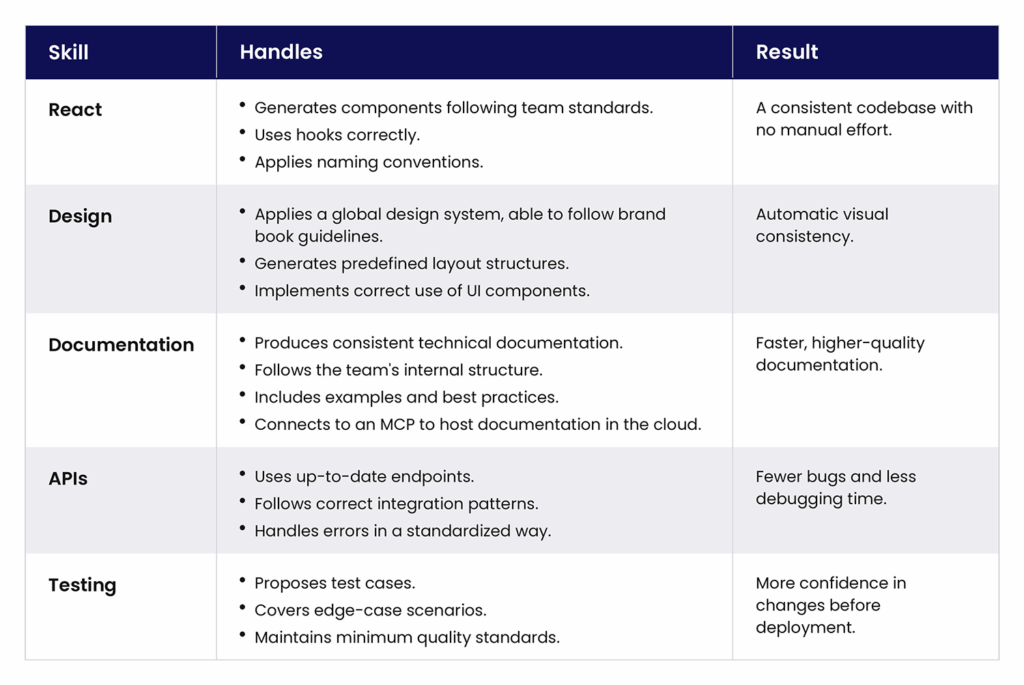
In every one of these cases, the underlying idea is the same: we’re turning the team’s collective knowledge into something the AI can reuse. In practice, that means we can now build a team tailored exactly to our needs, and stay firmly in control. We decide how they think, how they communicate with each other, and how they get the work done.
How to Design a Good Skill
A skill shouldn’t be a junk drawer of loose instructions. If you want it to actually work, it needs a clear structure. Here’s a framework I find useful:
- Purpose: what problem it solves and when it should be used
- Context: what domain knowledge the agent needs to have
- Behavioral rules: what it should do, what it should avoid, and what standards it must follow
- Examples: use cases that illustrate what a good result looks like
- Resources: links, templates, code snippets, or relevant documentation
- Review criteria: how you’ll validate that the output meets expectations
The more context you provide within this framework, the more specialized the agent becomes — and the better the results.
Resources to Get You Started
If you want to start exploring this approach, here are some key resources for your own projects:
Repositories
https://github.com/github/awesome-copilot/ → A GitHub community hub with a collection of tools and examples for working with AI in development
https://skills.sh/ → A platform for finding and installing reusable skills for your projects
Recommended first steps
- Identify repetitive tasks in your daily work
- Define exactly how they should be done correctly
- Package that logic into a skill
- Test it on a real case and refine its behavior
- Share it with your team if it proves useful
Conclusion
The evolution of AI isn’t just happening in the models themselves, it’s happening in how we use and structure them.
Agent skills represent a genuine turning point: they make knowledge reusable, they let agents specialize as we feed them more context, and they lay the groundwork for far more sophisticated systems down the line.
This isn’t just about using AI agents, it’s about actually getting value out of them. And on that path, skills are shaping up to be one of the most important building blocks for moving from isolated experimentation to a more mature, scalable way of working with AI.