
Introduction: From users to owners
The internet is constantly evolving, and today’s digital world generates unprecedented volumes of content. However, users have historically lacked ownership over their data and creations. Web 3.0 emerges as a response to this imbalance, proposing a decentralized, user- centric internet in which individuals regain control over their digital identities, assets, and interactions.
The evolution of Internet: Web 1.0 to Web 3.0
Web 1.0: Read-only Internet
Web 1.0, created during the 80s, consisted of static, centralized websites with minimal interaction (usually used by investigators). Users consumed information but had no meaningful way to participate or influence content. Websites functioned as digital brochures, offering limited functionality and no personalization.
Web 2.0: Read-Write, Platform-Owned
The emergence of Web 2.0 in the mid-2000s transformed the internet into a participatory space. Social media platforms, blogs, wikis, and content-sharing services enabled users to create, share, and interact with content on a scale. This change fueled innovation, collaboration, and global connectivity. However, this participation came at a cost. Although users generated most of the content and data, ownership remained centralized. Large platforms stored user data in proprietary databases, monetizing attention, behavior, and personal information through advertising and analytics. The economic value created by users was largely captured by platform owners, reinforcing asymmetrical power structures and raising concerns about privacy, data exploitation, and digital dependency.
Web 3.0: Read-Write-Own
Web 3.0 introduces a new paradigm by embedding ownership directly into the internet’s architecture. Through decentralized networks and blockchain technology, users can hold, transfer, and manage digital assets without relying on centralized authorities. Identities, data, and value are no longer controlled by platforms but by cryptographic mechanisms secured by distributed networks.
This shift enables peer-to-peer interactions governed by transparent rules encoded in software. Users become stakeholders rather than products, and participation is increasingly aligned with ownership and governance rights.
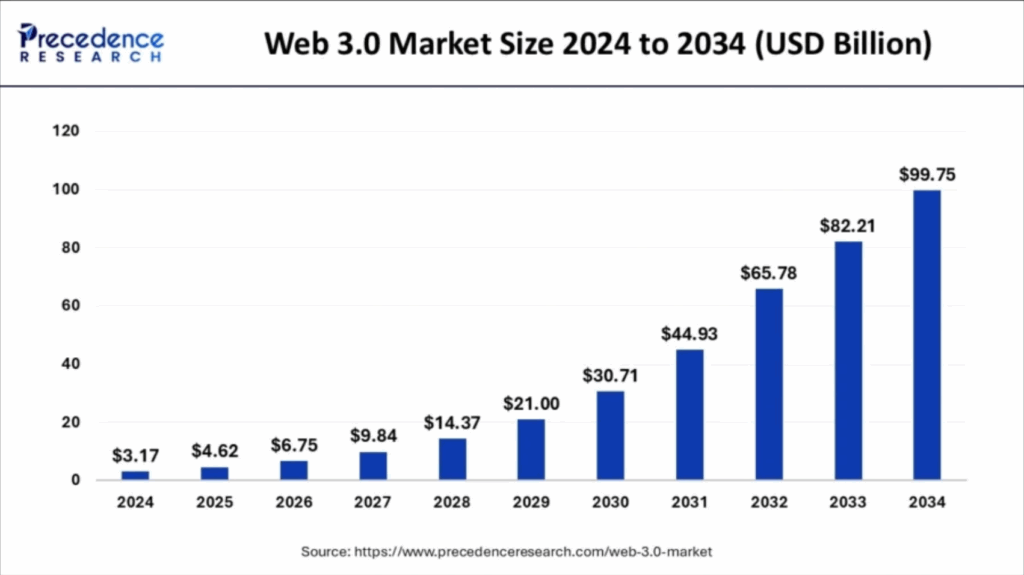
The Infrastructure of Web 3.0
Blockchain as a Trust Layer
At the heart of Web 3.0 lies blockchain technology, which functions as a decentralized trust layer. Instead of relying on databases or institutions, blockchains distribute data across networks of independent nodes. Each transaction or data update is cryptographically verified and recorded in an immutable ledger, ensuring transparency and resistance to manipulation.
This architecture enables trustless systems, where participants do not need to know or trust each other personally. Trust is shifted from institutions to code and consensus mechanisms. As a result, value can be exchanged globally with reduced friction, fewer intermediaries, and greater resilience against censorship or single points of failure.
Smart Contracts and dApps
Smart contracts are self-executing programs stored on the blockchain that automatically enforce agreements when predefined conditions are met. They eliminate the need for manual intervention, reducing costs, delays, and the risk of human error.
Decentralized applications (dApps) build on smart contracts to offer services ranging from finance and gaming to identity management and content distribution. Unlike traditional applications, dApps do not rely on centralized servers. Their logic is transparent, their data is distributed, and their governance can be shared among users.
This model promotes openness and accountability while enabling new forms of collaboration and economic organization.
Decentralized Storage and Edge Computing
Web 3.0 also rethinks how data is stored and accessed. Decentralized storage solutions such as IPFS (Interplanetary File System) distribute encrypted data across multiple nodes rather than concentrating it in centralized data centers. This approach enhances security, reduces vulnerability to outages, and improves data sovereignty.
When combined with edge computing and high-speed networks, decentralized storage supports data-intensive applications such as immersive virtual environments, gaming ecosystems, and AI-driven platforms. Processing data closer to the user reduces latency and enhances performance, making decentralized systems increasingly viable at scale.
Tokens, NFTs and Digital Ownership
Tokens and Value Creation
Tokens are the foundational units of value in Web 3.0 ecosystems. Created through smart contracts, they can represent a wide range of rights and functions, including access to services, participation in governance or claims on real-world assets.
Utility tokens grant access to specific features within a platform, while governance tokens enable holders to vote on protocol upgrades, economic parameters, or strategic decisions.
In some cases, tokens represent tokenized real-world assets, such as art, real estate, or intellectual property, bridging digital and physical economies.
NFTs and Digital Property Rights
Non-fungible tokens (NFTs) take a long-standing challenge of the digital era: proving ownership of unique digital items. Unlike traditional digital files (which can be copied endlessly) NFTs are unique, indivisible and verifiable on the blockchain.
NFTs allow creators to monetize digital art, music, collectibles, and virtual goods while retaining origin and rights. Beyond art, NFTs are increasingly used in gaming, digital identity, licensing and access control, demonstrating that ownership in Web 3.0 extends far beyond speculative markets.
Importantly, NFTs do not store the content itself but rather a verifiable record of ownership and authenticity, reinforcing the distinction between possession and authorship.
Challenges and Open Questions
Despite its promise, Web 3.0 faces significant challenges. Scalability remains a technical problem, as decentralized networks must handle growing volumes of transactions without sacrificing security or decentralization. User experience is another barrier, as wallets, private keys, and cryptographic concepts can be difficult for non-technical users.
Legal and regulatory frameworks are still catching up, particularly regarding digital assets, taxation, and consumer protection. Security risks, including smart contract vulnerabilities and fraud, also highlight the need for better standards and education.
These challenges underscore that Web 3.0 is not a finished product but an evolving ecosystem that will change the world in near future if adoption keeps growing.
Conclusion: Ownership as a WIP (Work in Progress)
Web 3.0 represents a structural redefinition of the internet. By combining blockchain, tokens, NFTs, and decentralized governance, it introduces the technical foundations for verifiable digital ownership and peer-to-peer coordination at a global scale. Rather than eliminating platforms, it rebalances power by embedding ownership and control at the protocol level.
For this reason, organizations should not approach Web 3.0 as an immediate, full replacement of existing architecture. Instead, a progressive and strategic adoption is recommended. This involves gradually integrating selected Web 3.0 components into existing web platforms, prioritizing those areas where the organization has a clear vision ofvalue creation, user evolution, and long-term scalability.
Finally, information becomes as important as how it is owned or secured. Augmented Reality and the Spatial Web represent the next step in this evolution, enabling digital content to be displayed in immersive, three-dimensional environments that adapt dynamically to each user. When combined with decentralized identity, blockchain-based permissions, and AI- driven personalization, these technologies allow information to be structured around the specific context, role and needs of the individual interacting with the platform. The next article will explore how client-centric information architectures, spatial interfaces, and augmented reality redefine user interaction, transforming static web experiences into adaptive, intelligent, and immersive digital spaces. Stay tuned.
Key Takeaways
• Blockchain enables trustless ownership and secure peer-to-peer transactions
• Tokens and NFTs redefine digital property and creator monetization
• Governance shifts from centralized authorities toward community-driven models
• Web 3.0 offers a paradigm shift that currently needs greater adoption.
• Any system developed on the blockchain offers freedom, suitability, and trustless endpoints
Read part 2 of this article here:
Bibliography
• https://ethereum.org/es/web3/
• https://www.kraken.com/es/learn/what-is-web3
• https://www.pictet.com/is/en/insights/web-3-0-more-than-just-the-internet
• https://www.bitpanda.com/es/academy/que-es-la-web3
• https://www.researchgate.net/publication/395529812_Web_30_The_Next_Evolution_of_the_Internet
• https://thehyperstack.com/blog/how-web-3-0-will-change-the-way-we-use-the-internet/