
Introduction: Web 3.0 Beyond Theory
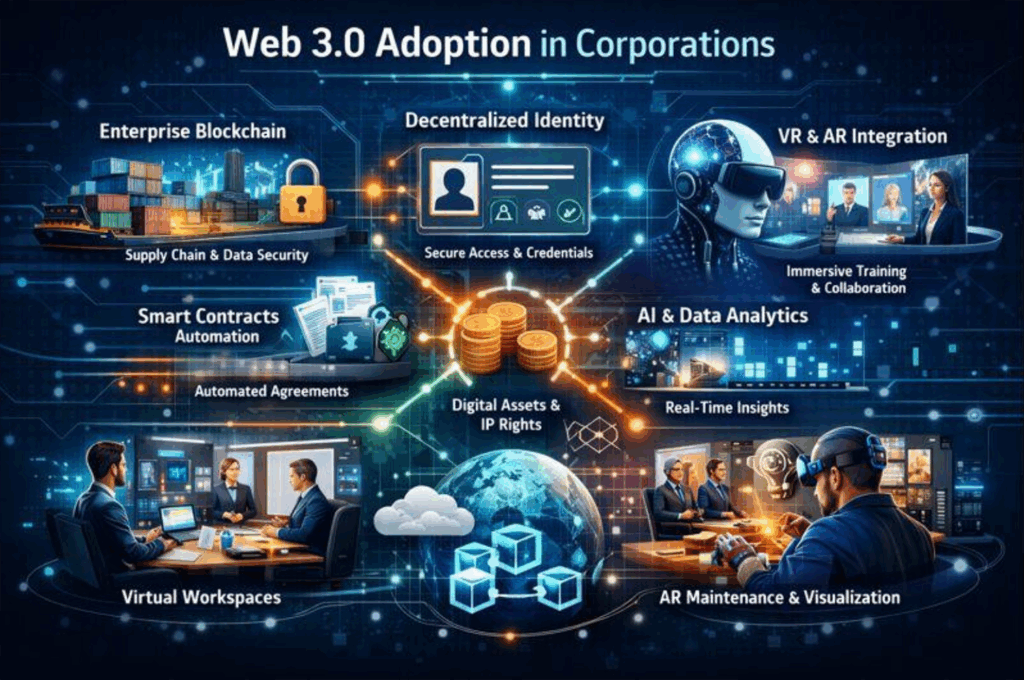
While the first wave of Web 3.0 discussion focused on decentralization, ownership, and individual empowerment, its real test lies in enterprise adoption. Corporations and large organizations are now exploring how Web 3.0 technologies (blockchain, smart contracts, tokens, and decentralized identity) can be integrated into existing business models to improve efficiency, transparency, and trust.
At the same time, the convergence of this technology with Virtual Reality (VR), Augmented Reality (AR), and spatial computing is opening new possibilities for how businesses visualize data, train employees, interact with customers, and manage digital assets. This article examines how Web 3.0 is being applied in enterprise contexts, highlighting both successful implementations and current challenges.
Web 3.0 in Corporate and Enterprise Environments
Blockchain as Enterprise Infrastructure
In corporate settings, blockchain is increasingly adopted as a shared ledger rather than a purely public or permissionless network. Enterprises often use private blockchains to coordinate data across departments, suppliers, and partners.
Typical use cases include:
• Supply chain traceability
• Secure data sharing between organizations
• Automated compliance and auditing
• Cross-border payments and settlement
By reducing reconciliation costs and manual verification, blockchain enables organizations to operate with higher transparency and lower operational friction between groups or teams.
Smart Contracts and Process Automation
Smart contracts are increasingly used to automate business logic that traditionally requires legal oversight, intermediaries, or manual validation. In enterprise environments, they are applied to areas such as licensing, royalty distribution or service-level agreements.
For example, a smart contract can automatically release payment once delivery conditions are verified, reducing disputes and delays. However, enterprises must carefully design these contracts, as errors in code can have immediate and irreversible consequences.
Smart contracts work best when processes are clearly defined, rule-based, and auditable.

Web 3.0 and Corporate Identity Management
Decentralized Identity in Organizations
Traditional enterprise identity systems rely on centralized directories and credential providers. Web 3.0 introduces decentralized identity (DID) models, allowing employees, partners, and customers to control verifiable credentials without exposing unnecessary personal data.
In corporate environments, this enables:
• Secure access management across platforms
• Reduced identity fraud
• Compliance with data protection regulations
• Cross-company authentication without shared databases
Although adoption is still limited, decentralized identity is particularly promising in regulated industries such as finance, healthcare, and logistics.
Integration with Virtual Reality, Augmented Reality, the Spatial Web and use Of AI
Integration with Virtual Reality, Augmented Reality, and the Spatial Web
The integration of Web 3.0 with VR and AR transforms how enterprises present information and interact with digital environments. Rather than relying on flat dashboards or static reports, organizations can visualize data spatially and contextually.
Key applications include:
• Immersive employee training and simulations
• Virtual collaboration spaces for remote teams
• AR-assisted maintenance and industrial operations
• Spatial visualization of supply chains, factories, or digital twins
Blockchain ensures that digital assets, permissions, and identities within these environments are secure, verifiable, and transferable.
The Role of Artificial Intelligence in Immersive Web 3.0 Environments
Artificial Intelligence plays a critical role in making VR and AR applications usable, scalable, and truly client-centric within Web 3.0 enterprise environments. While blockchain provides trust, ownership, and verifiability, AI acts as the interpretation and orchestration layer that transforms complex data into meaningful experiences.
In immersive environments, AI enables real-time analysis of user behavior, context, and intent. This allows virtual and augmented interfaces to adapt dynamically: highlighting relevant information, filtering unnecessary data, and guiding users through complex systems based on their role, expertise, or objectives. For example, an AI-driven AR interface can prioritize operational data for a technician, strategic insights for a manager, or product features for a customer, all within the same spatial environment.
AI is also essential for managing the cognitive load inherent in immersive systems. By summarizing blockchain data, automating pattern recognition, and generating contextual explanations, AI ensures that users interact with insight rather than raw information. This combination of AI, Web 3.0, and immersive technologies transforms VR and AR from visual tools into intelligent decision-support systems, making them viable for real enterprise use rather than experimental showcases.
Benefits and Trade-Offs in Enterprise Adoption
Enterprise adoption of Web 3.0 has been somewhat sluggish, primarily because large-scale organizational change can be daunting. Nevertheless, early adopters have spent the past few years gathering data to weigh the potential benefits against the risks and drawbacks outlined below
Benefits
• Increased transparency and auditability
• Reduced dependency on intermediaries
• Improved data integrity and trust
• New business models and revenue streams
Counterparts and Risks
• Technical complexity and skills gap
• Legal and regulatory uncertainty
• Scalability and performance limitations
• Cultural resistance within organizations
Conclusion: A Strategic Tool, not a Universal Solution
Web 3.0 offers powerful tools for enterprises, particularly when combined with immersive technologies such as VR and AR. Its true value lies not in replacing existing systems as a whole but in strategically enhancing them where decentralization, transparency, and digital ownership provide measurable benefits.
As corporate adoption continues, successful organizations will be those that approach Web 3.0 pragmatically (experimenting, learning, and integrating gradually) while keeping user experience, compliance, and long-term scalability at the center of their strategy.
Key Takeaways
1. Web 3.0 as Enterprise Infrastructure
Blockchain and smart contracts provide reliable, transparent foundations for cross- organizational collaboration and automation.
2. Immersive Technologies Multiply Value
The integration of Web 3.0 with VR and AR enables spatial visualization, training, and collaboration beyond traditional interfaces.
3. Client-Centric Information is a Competitive Advantage
Decentralized identity and AI-driven personalization allow enterprises to follow information securely and contextually.
4. Success Requires Strategy, Not Hype
Projects succeed when Web 3.0 is adopted incrementally with clear business objectives, not as a full system replacement.
5. Risks Remain Real
Scalability, regulation, and usability continue to challenge enterprise adoption and require careful planning.
If you missed part one of this article, read it here:
Bibliography
https://ethereum.org/en/decentralized-identity
https://ethereum.org/en/developers/docs/smart-contracts
https://www.kraken.com/es/learn/what-is-web3
https://www.bitpanda.com/es/academy/que-es-la-web3
https://www.pictet.com/is/en/insights/web-3-0-more-than-just-the-internet
https://www.britannica.com/money/what-is-blockchain
https://thehyperstack.com/blog/how-web-3-0-will-change-the-way-we-use-the-internet
https://www.researchgate.net/publication/395529812_Web_30_The_Next_Evolution_of_the_Internet